Connecting the Dots: Contracts, Circuits and Cost Savings

Wholesale Contracts Contain Critical Data That Can Make or Break Your Business. Here’s What It Takes to Leverage Contract Data for Success.
The U.S. telecom wholesale market is a multi-billion-dollar industry that plays a crucial role in supporting Communication Service Providers (CSPs) with network infrastructure, data services and circuit management. Effective telecom contract management is essential to keeping the hundreds of agreements, circuits, rates and service commitments behind these relationships under control.
Even though Tier 1 providers own massive networks, they cannot physically reach every single office building, cell tower or rural data center in the world. Providers must lease “last-mile” circuits from local incumbent carriers, like a regional utility, local phone company or tower operator, to connect customers to their core network.
The resulting wholesale partnership begins with a Master Service Agreement (MSA), which serves as the overarching legal umbrella. Many CSPs manage hundreds of distinct wholesale vendor agreements just to stitch together these off-net circuits. Individual circuits are then added underneath, adding more layers of information.
The MSA establishes the core legal relationship. It defines liability, indemnification, payment terms (e.g., Net 30), and dispute resolution processes. Each MSA is then supported by a separate service schedule for every circuit or capacity block purchased. These typically detail the exact A-end and Z-end locations, bandwidth and contract duration. These contracts also get updated periodically, which can impact other downstream systems.
Wholesale contracts also come with strict performance metrics and SLAs that require close tracking. For instance, if a fiber line is cut, the carrier may face heavy financial penalties if it does not meet repair timelines (usually a 4-to-6-hour Mean Time to Repair). Aside from tracking performance metrics and SLA requirements, there are other risk factors that come with managing these complex contracts:
- Billing vs. Inventory Mismatch: A glaring vulnerability in telecom is that billing frequently diverges from real network conditions. Tier 1 providers regularly pay local vendors for leased circuits they don’t fully use, or worse, for “ghost lines” that no longer carry any live network traffic.
- Contractual Inertia & Auto-Renewals: Last-mile lease agreements often include rigid timelines and automatic renewal clauses. If a carrier doesn’t track expiration dates systematically, contracts roll over unnoticed for years, trapping it in old, above-market rates.
- Stranded Out-of-Contract Assets: When an enterprise customer cancels a circuit service, the Tier 1 provider must promptly cancel the underlying last-mile circuit lease it bought from the local vendor. If that disconnection process fails, the carrier keeps paying for a dead circuit, destroying its profit margins.
In the end, this leaves thousands of details across hundreds of contracts that need to be tracked and monitored against a daily stream of ongoing business transactions.
Meanwhile, at the end of every month, billing discrepancies are common. Dedicated wholesale dispute teams spend significant time auditing invoices against their own internal network logs to reconcile differences before final wire transfers are made. But critical contract (and other) information often gets lost in the shuffle. It’s stored in various places across the organization and in a variety of formats that are not easily searchable, extractable or calculable, making this monthly process even more challenging.
Why Contract Details Matter for Day-to-Day Operations
Because circuit contracts are high-volume, highly complex and long-term, they introduce massive operational risks for telecom financial teams. It’s important for CSPs to be aware of contract nuances, and to tie contracts to circuits, orders and invoices, and vice versa. Unfortunately, most CSPs struggle to do this. Lacking an in-depth view into these hierarchical relationships and their business impact can lead to significant long-term losses.
For example, a leading operator underwent a series of acquisitions. As a result, they had many newly acquired network circuits and term plans, along with software tools and data sources, that all needed to be integrated into the carrier’s existing systems. This operator knew they were paying for more leased circuits than needed, but data integrity issues limited their ability to identify which ones could go.
TEOCO was tasked with helping to solve this dilemma. By automating the comparison of circuit data from the Operator’s network elements, provisioning systems, vendor invoices and contracts to their audit facility and usage invoices, we were able to accurately identify unused circuits – resulting in significant ongoing cost savings. We also identified additional “opportunity” circuits that could be disconnected, saving them even more. In the end, we were able to secure $85 million in overall savings.
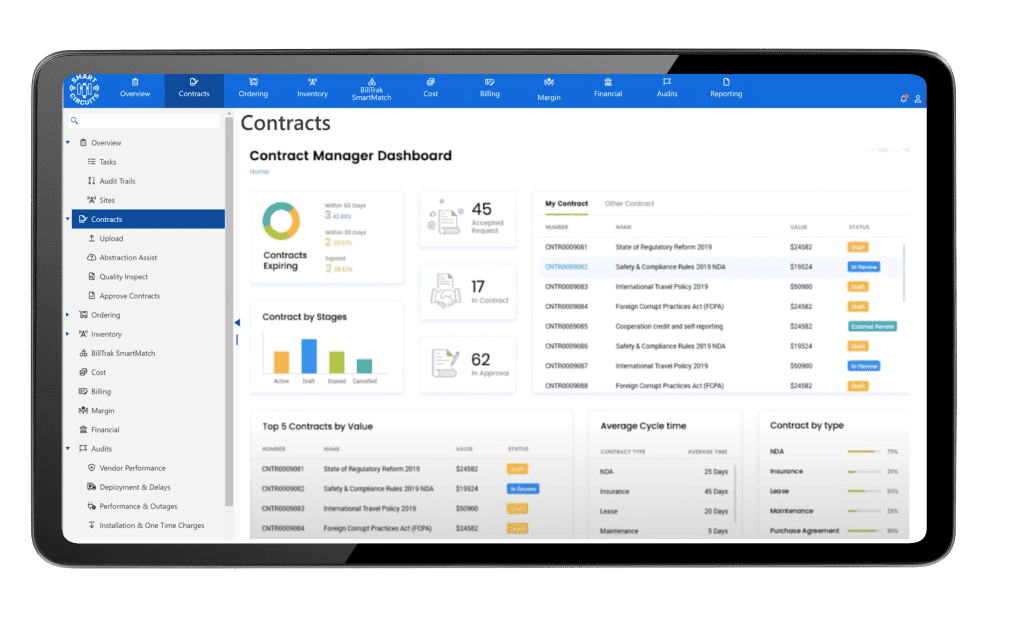
SmartCircuit’s Contract Management Module Provides Instant Access to Valuable Information
Many contract, order and circuit inventory systems in the market today lack auditable workflows, change management and approval processes for enforcing controls throughout the circuit lifecycle.
TEOCO’s SmartCircuit® allows CSPs to take more control of their wholesale business by providing ‘cradle-to-grave’ oversight. It allows users to continuously analyze each circuit – from contracts and orders to circuit inventory, margin assurance and more. It validates the financial accuracy of contract commitments and instantly links circuits to contracts for improved oversight.
SmartCircuit’s contract management module helps CSPs stay on top of all the various contracts, vendor rate sheets and SLAs. By digitizing and centralizing the data, contracts become easily searchable. This means users can track circuit prices, availability, performance, minimums, discounts, duration terms and more. They can make more informed decisions and even leverage the data in ways that can benefit other areas of the organization.
Integration with the other SmartCircuit modules adds even further value by enabling users to track and compare vendor contract terms and conditions, and to detect SLA violations and their associated credits. In fact, SmartCircuit automatically monitors and tracks SLA violations and enforces contract terms, taking the pressure off already overworked staff.
Don’t underestimate the importance of choosing the right tools when it comes to your wholesale business. For more information on SmartCircuit and what it can do for you, download the solution guide here.